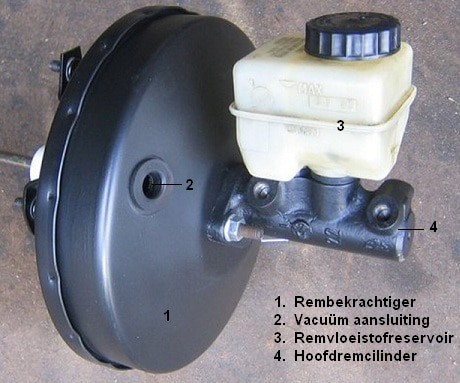
Introduction to the Master Cylinder:
The master cylinder is mounted on the brake booster. On top is the brake fluid reservoir, which provides for the supply and return of brake fluid. When the brake pedal is pressed, fluid pressure is built up in the master cylinder through the vacuum action in the brake booster. From the master cylinder, the pressure moves via brake hoses and brake lines to the wheel brake cylinders.
Nowadays, we only use tandem master cylinders. This divides the brake system into 2 brake circuits:
- One circuit for the front wheels and one for the rear wheels.
- Diagonally split brake circuits; where one circuit operates the left front wheel and the right rear wheel. The second circuit then operates the right front wheel and the left rear wheel.
- When using disc brakes with multiple pistons per caliper, each caliper can be operated by 2 separate circuits.
The image below shows a vehicle with a diagonally separated brake circuit. The red line indicates the brake circuit of the left front wheel and the right rear wheel. The blue line indicates that of the right front and left rear.

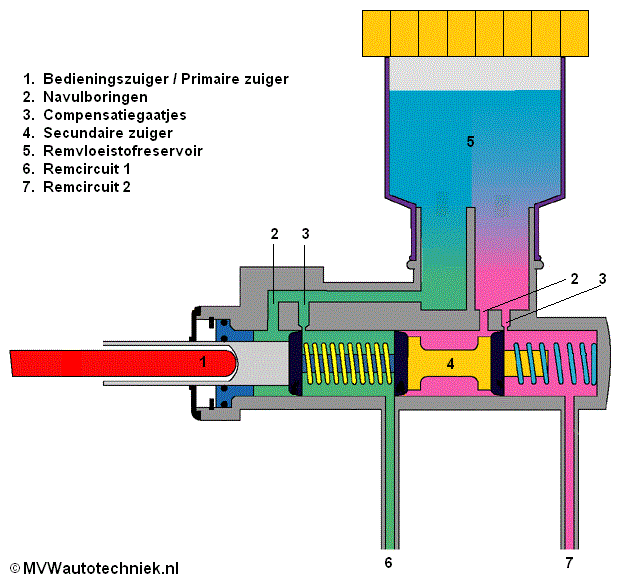
Operation:
The tandem master cylinder is shown in the image at rest. So, no braking occurs now. The springs of the primary and secondary pistons push both the operating piston and the primary piston to the left, so the space near the borings 3 becomes free. The brake fluid reservoir is divided at the bottom into 2 separate sections. When a section of the brake system leaks and a brake circuit becomes empty, it does not affect the other brake circuit. The braking function is preserved through the other circuit.
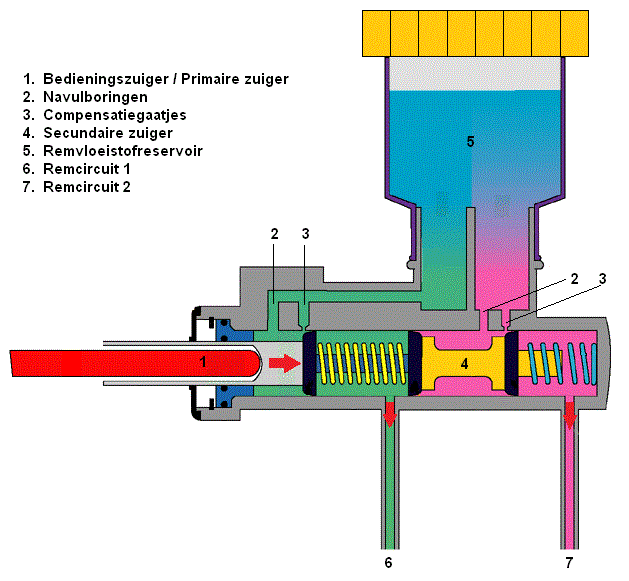
During braking:
The operating piston (1) moves to the right. As the fluid is incompressible, the fluid also moves the secondary piston. If there is a leak in the primary brake circuit, mechanical contact occurs between the primary and secondary pistons. When the primary cups pass the compensation holes (3) (as in the image), pressure builds up. The brake fluid is pressed to the wheel brake cylinders, bringing the brakes into operation. The further the operating piston 1 is moved to the right, the higher the brake pressure becomes. Both pistons move simultaneously to the right because the (left) spring behind the primary piston has a greater pre-tension than the (right) spring next to the secondary piston. When braking stops, the operating piston moves back to the left, and both springs push the primary and secondary pistons back to the basic position.
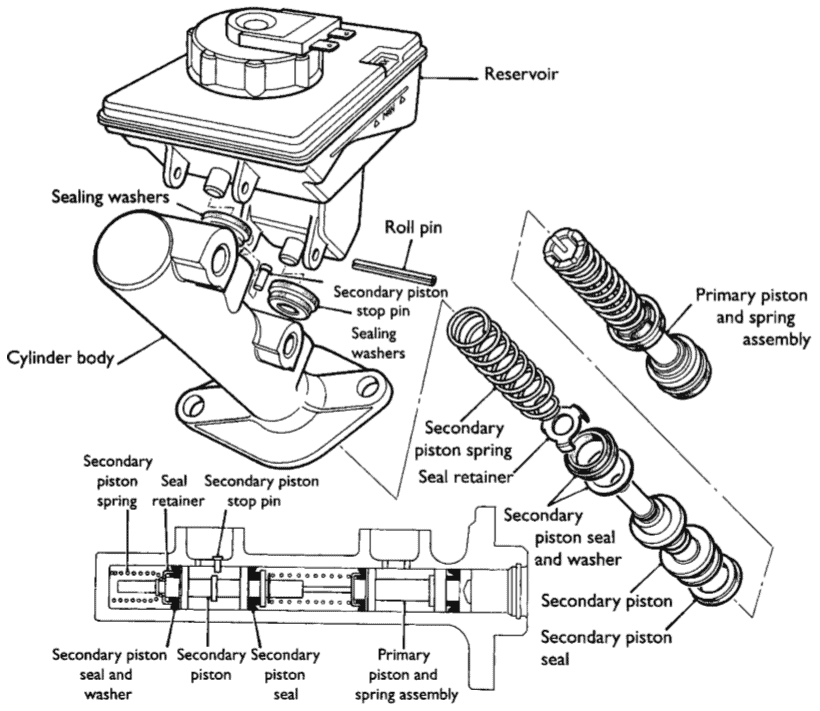
The image below shows an exploded view of the components in the master cylinder with the brake fluid reservoir.
Failures:
Failures in the brake system can be caused by defects in the master cylinder. Two situations characteristic of a defect in the master cylinder are described below.
- Failure 1: When the brake pedal sinks further while constant force is applied to it, it appears that there is a pressure loss in the system. Initially, one might think of a leak. If no leak is found but the brake pedal continues to sink, then the problem may be in the master cylinder. The primary cup sealing the space between the compensation holes (3) and the brake circuit may be leaking. The brake fluid is pressed into the brake circuit by the primary or secondary piston. Due to the leaking cup, the fluid slowly flows back through the compensation hole to the brake fluid reservoir.
The problem is resolved by replacing the brake cups, but normally the entire master cylinder is replaced for this.
- Failure 2: If the seal of the operating piston (at the far left in the image) leaks, brake fluid may run directly from the master cylinder into the brake booster. This may affect the operation of the brake booster, and the primary brake circuit (1) may lose brake pressure due to a lowered brake fluid level. If all fluid leaks out of the primary brake circuit (in a diagonally split system where the primary brake circuit brakes only the left front wheel and the right rear wheel), the secondary brake circuit will absorb all braking forces. Since the secondary brake circuit only brakes the right front wheel and the left rear wheel, braking performance will be greatly reduced. However, the most important thing is that the car can still be brought to a stop.